ADER is a fictional software that builds battery passports from real supply-chain data. In 60 seconds the film explains an EU obligation that starts in 2027 – and why real data is worth more than default values. Here you can see how it was made.
From 2027, EV, e-bike and large industrial batteries in the EU need a digital passport. ADER collects the data directly from suppliers – from the nickel mine to the QR code on the type plate. With German narration.
01
Concept film, not a client commission. Companies, serial numbers and CO₂ values are invented.
Step 01 · Product & goal
From 2027: no passport, no sale.
From 18 February 2027, batteries for electric vehicles and light means of transport such as e-bikes, as well as industrial batteries above 2 kWh, need a digital battery passport in the EU: where the raw materials come from, what the battery contains, its carbon footprint. In the film it's 94 required data points. The data sits with suppliers in many countries – today it often takes weeks of emails and spreadsheets to collect.
The question for the film: how do you turn an obligation that sounds like paperwork into a story people understand in a minute? The answer: follow a single cell – from nickel in Indonesia to the QR code on the type plate. And show that real data is more than compliance.
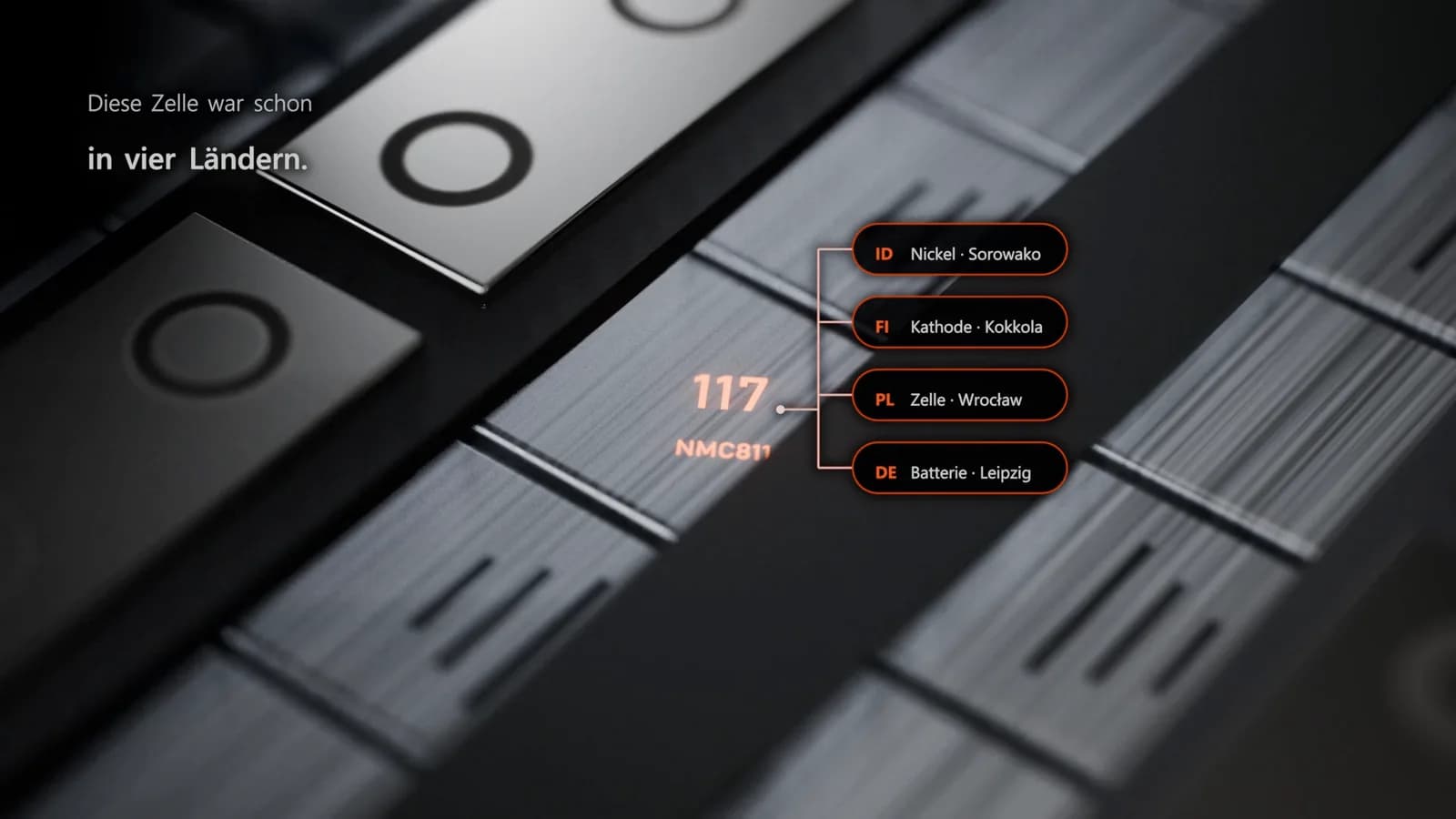
Cell 117 · NMC8114 countries
IDNickelSorowako
FICathodeKokkola
PLCellWrocław
DEBatteryLeipzig
Carbon footprint · kg CO₂e/kWh−21%
Default value81
Primary data from Kokkola64
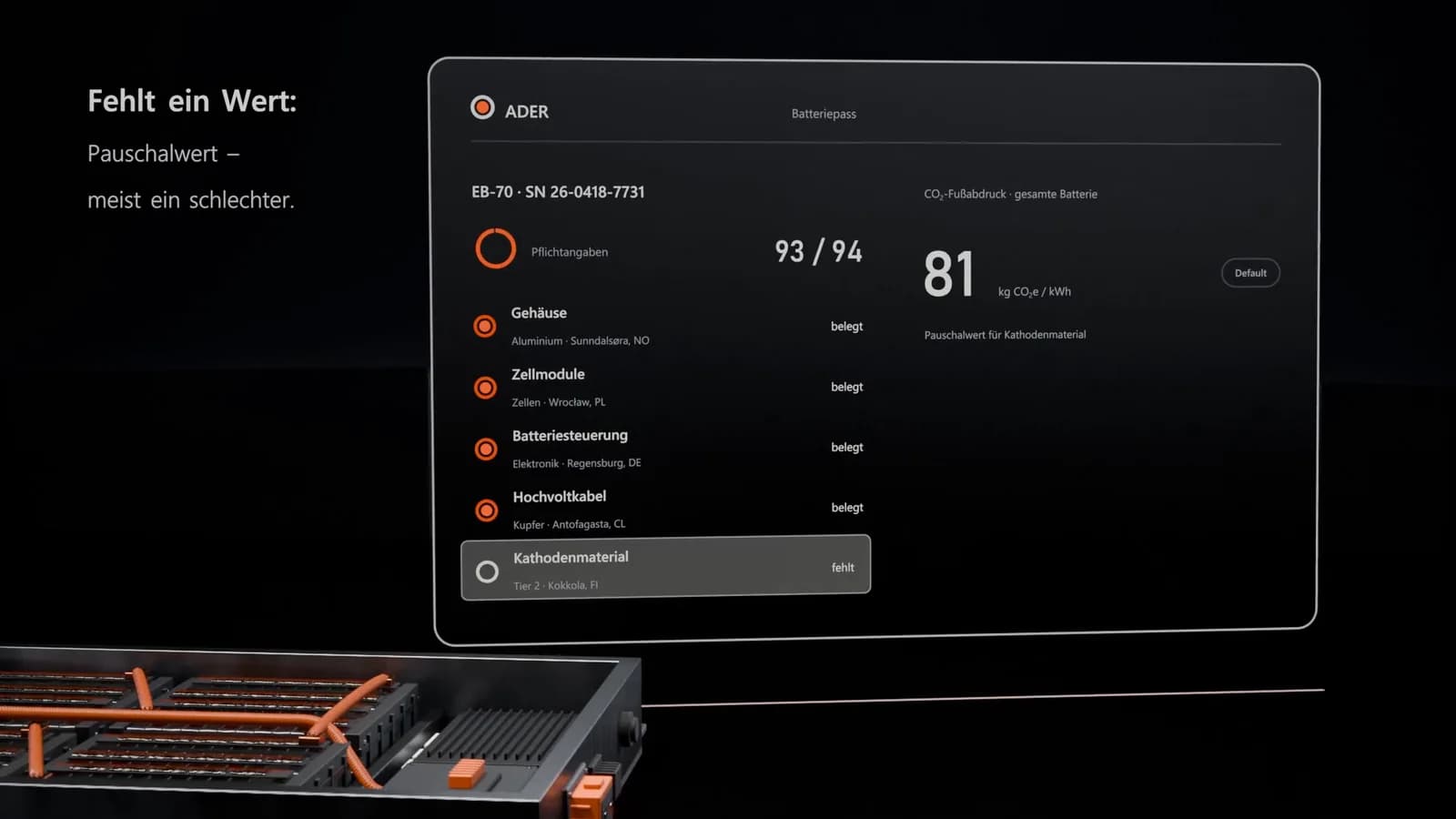
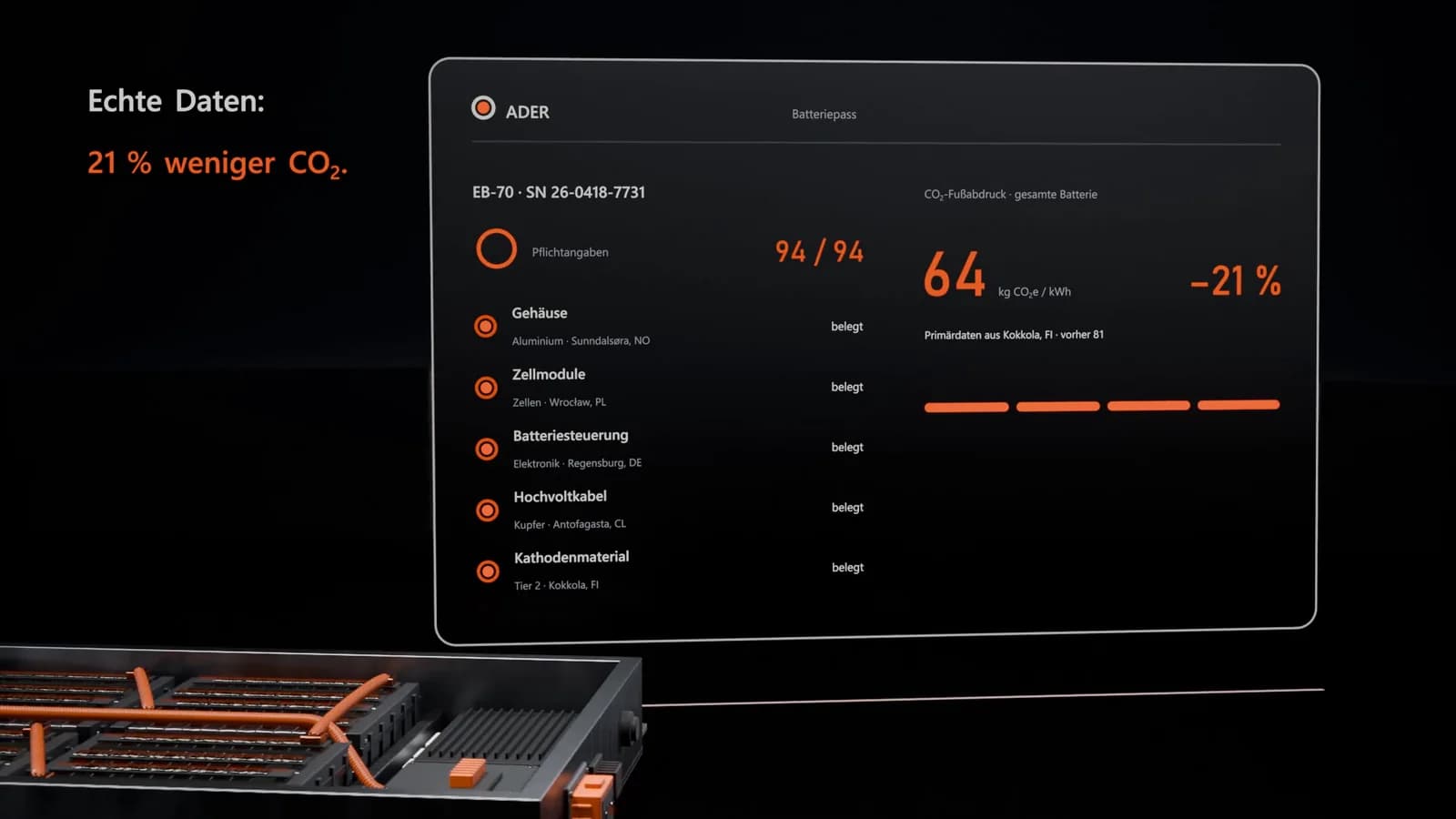
The cathode material is missing a value, so the passport calculates the whole battery with the default: 81 kg CO₂e/kWh. ADER asks the supplier in Kokkola – with the real data it's 64, or 21% lower.
Step 02 · Scene plan
The film, second by second.
This is what the scene plan you receive for free before we start looks like: what is shown when, and what is said. Animation only starts once it fits.
Scene plan · ADER12 scenes · 01:00Approved
Time
Picture
Narration (translated from German)
00:00
Macro shot of brushed-metal battery cells. Cell 117 lights up “NMC811” and four stations unfold beside it: nickel from Sorowako, cathode from Kokkola, cell from Wrocław, battery from Leipzig.
“This cell has already been through four countries.”
00:04
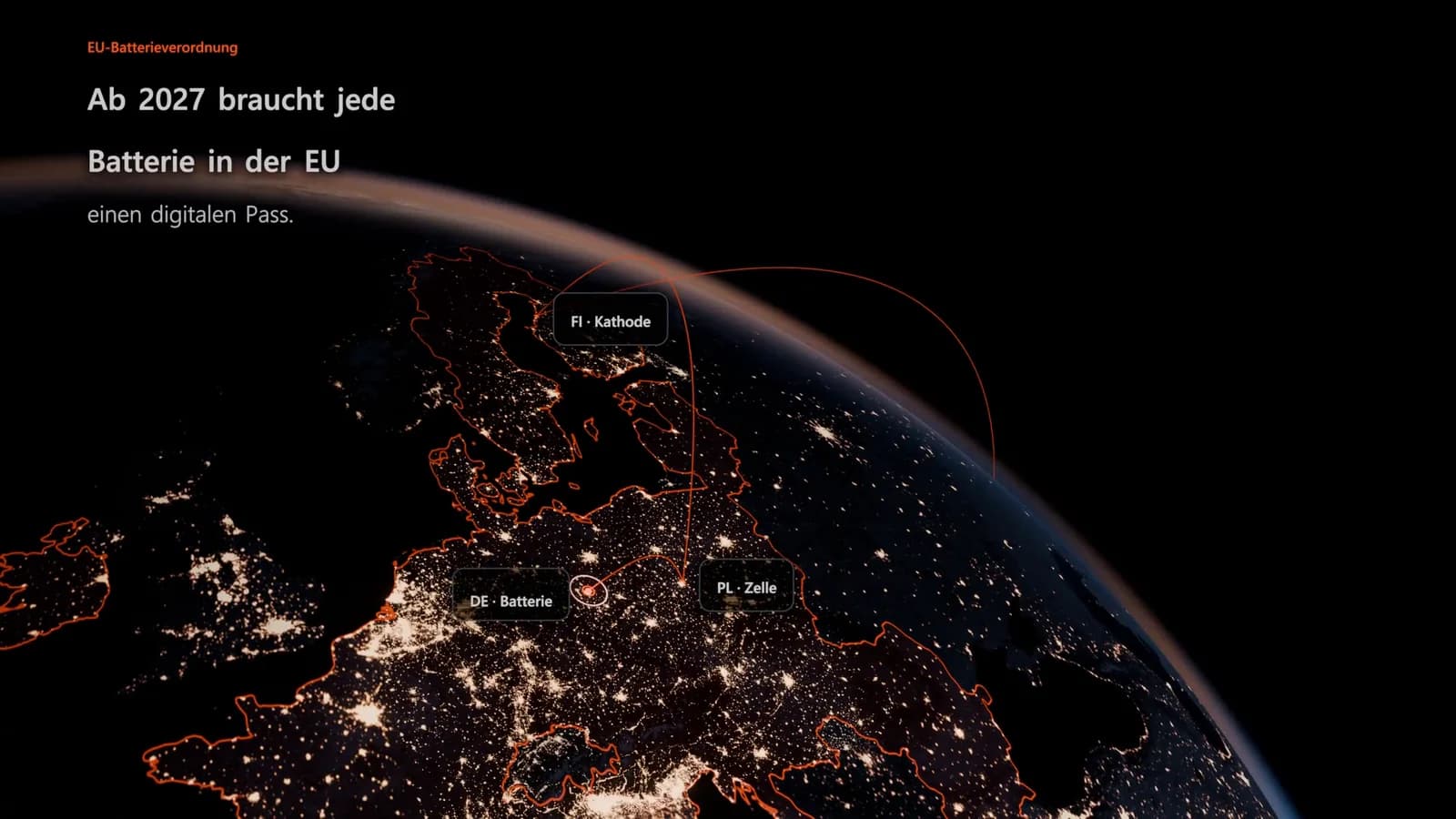
An orange pulse races across the cell, cut to the Earth at night. The cell's route spans Europe, with the caption: EU Battery Regulation.
“From 2027, every battery in the EU needs a passport.”
00:09
The EU border lights up, a ring pulses over Leipzig.
“No passport, no sale.”
00:11
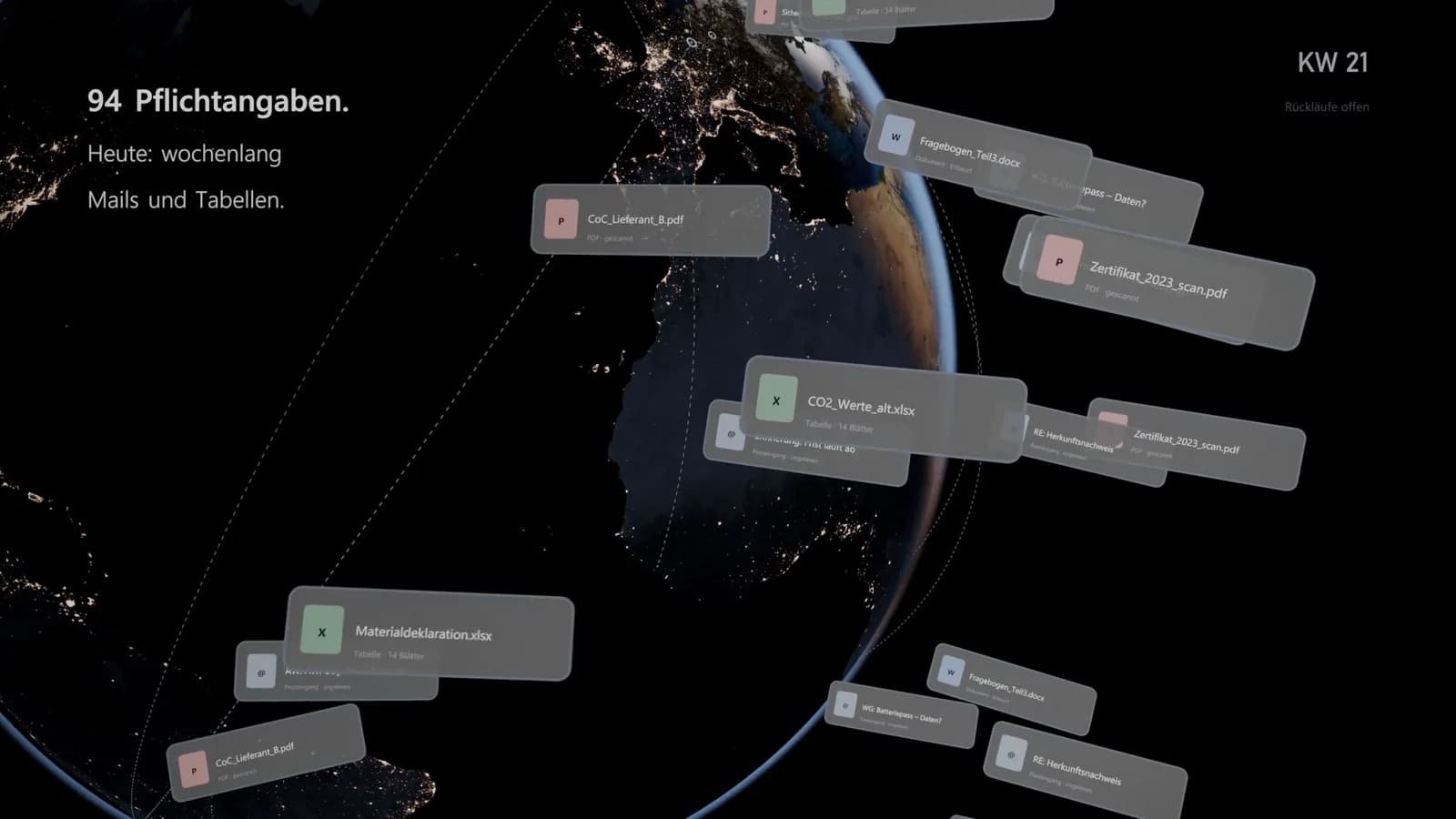
The camera pulls back. Emails, PDFs and spreadsheets drift around the globe while the calendar weeks tick by in the corner: week 15, week 18, week 21.
“Ninety-four required data points. Today: weeks of emails and spreadsheets.”
00:17
An orange ring sweeps the files away. Lines shoot out to the mines – cobalt from Kolwezi, lithium from the Atacama – and the counter jumps to 93 / 94.
“ADER collects the data automatically. Directly from the supplier.”
00:23
Serial numbers run across Europe: ADR-24-0117, -0118, -0119 …
“For every serial number.”
00:25
The battery pack in 3D: high-voltage cables, control unit, modules. Beside it the battery passport opens as a glass interface.
– (music)
00:29
The cathode material from Kokkola is missing a value, so the passport calculates the whole battery with the default: 81 kg CO₂e/kWh. A click on “Request primary data”.
“If a value is missing, a default applies – usually a bad one.”
00:34
A flight to Kokkola in Finland. The request is running: day 1, day 2, day 4 – awaiting reply.
“ADER follows up with the supplier.”
00:37
The answer is in: 94 / 94 data points, 64 instead of 81 kg CO₂e/kWh. Beside it, “−21%” lights up.
“Real data: 21% less CO₂. An advantage in every tender.”
00:43
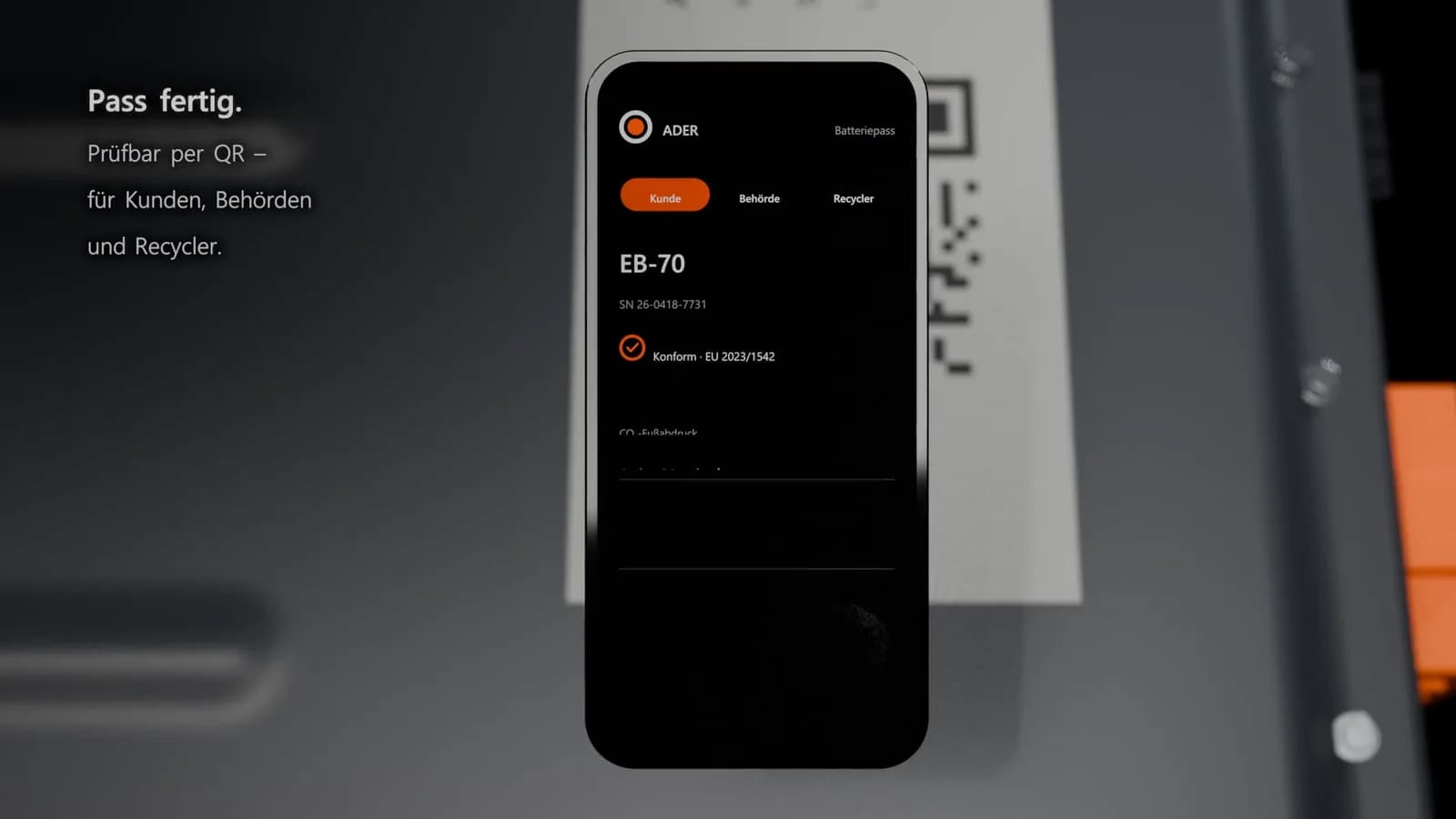
The lid closes and a laser burns the QR code onto the type plate. A smartphone scans it and shows the passport for customers, authorities and recyclers.
“Passport done. Verifiable by QR – for customers, authorities and recyclers.”
00:51
The Earth with every supply chain, beside it the ADER mark: “Battery passports from real supply-chain data.” and “Request a demo”.
“ADER. Battery passports from real supply-chain data. Request a demo now.”
Before anything moves, 3–6 key frames set colour, composition and look. ADER had six: night, metal and a single orange for everything the software does.
01
The hook
One cell, four countries: the supply chain is inside the product itself.
02
The obligation
From 2027, EV, e-bike and large industrial batteries in the EU need a passport. The cell's route shows why that is hard.
03
The problem
94 data points, scattered across emails and spreadsheets. The weeks go by.
04
The gap
The cathode material is missing a value, so the whole battery is calculated with the default: 81 kg CO₂e/kWh.
05
The advantage
Real data from Kokkola: 64 instead of 81 – 21% less CO₂.
06
Passport done
The QR code on the type plate, verifiable for customers, authorities and recyclers.
Why it works
Three decisions behind the film.
01
One cell as the lead
Instead of explaining the regulation, the film follows a single cell through four countries. Paragraphs become a journey you understand in seconds.
02
From the globe to a single value
The camera flies from the supply chain into the battery pack and down to the one missing value. You see where every entry in the passport comes from – and why it matters.
03
Obligation plus advantage
The film doesn't stop at “compliant”: real data lowers the carbon value by 21%. A requirement becomes a sales argument – and a reason to request the demo.