
Start with the question, not the technique.
Does someone need to see the product's shape, understand how it works, or notice what sets it apart? That answer should decide the images. A beautiful camera move around a model can attract attention, but it may still leave the most important product question unanswered.
In 3D, the viewpoint, lighting and movement can be designed with precision. You can reveal a component hidden inside a housing or show a product before a filmable prototype exists. Those are useful reasons to choose 3D. The mere possibility of making it is not.
Where 3D helps – and where it does not.
3D is useful for hard-to-film details: an internal mechanism, several variants, a controlled sequence of movement, or a transition from a product's exterior to its function. A well-built model may also support new views and formats later.
Real people, a product's feel in use and a believable everyday setting often favour live footage. Existing photographs might be enough for a focused motion clip. Sometimes the strongest answer combines methods. I would not propose 3D as an automatic upgrade when simpler material communicates the point better.
Three shots. Three distinct jobs.
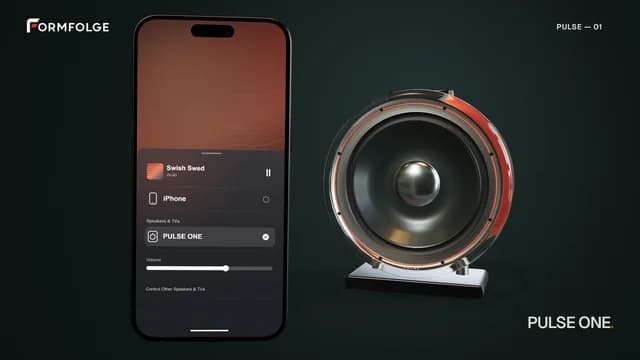
Connection
Put the app and speaker together so the interaction has context.
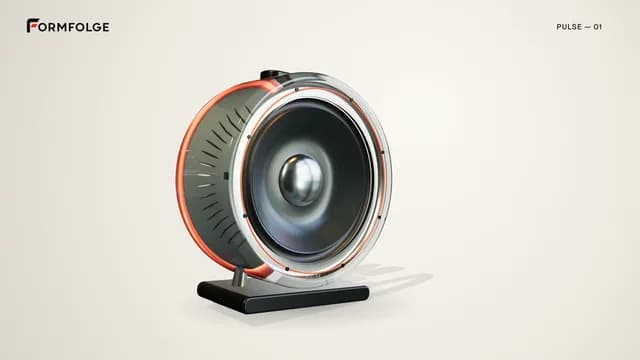
Product
Give form and material a view without competing elements.
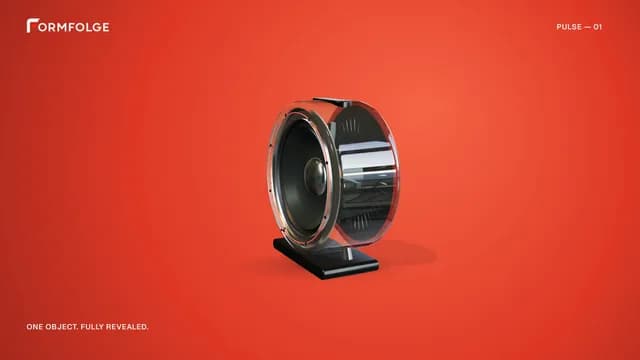
Final image
Leave viewers with a clear product silhouette.
What PULSE demonstrates.
PULSE is a self-initiated studio concept for a speaker. The film gives the app interaction, the product's form and selected details their own moments. It shows how 3D can guide attention: first the connection to the interface, then the object itself, then a distinct final image.
It is not a client commission or evidence of sales performance. It shows an approach to visual direction and scene planning. Whether that approach suits your product depends on what your audience needs to understand or see.
The assets that change the scope.
An existing 3D or CAD model can be a useful start. It still needs checking: are the proportions right, are the materials defined, and will it hold up close to the camera? A technical file is not necessarily a film-ready scene. If no model exists, building and approving one is part of the production.
Reference photos from several angles, dimensions, materials, logos and a note on what must be exact all help. From there, the number of distinct scenes, required detail, lighting, motion and deliverable formats shape the work. Runtime alone tells you little about that scope.
Choose a useful first step.
Send me a product link or a few images and describe one thing a viewer should understand after watching. I can assess whether one 3D shot, a short sequence or motion made from existing assets would do the job. If filming seems more suitable, I will say so.
The quote can then make the model, scenes, runtime, formats and revision rounds clear. A generic price per second would hide the work that matters. My product video pricing guide explains the other factors behind a quote.
Choose 3D when the product has something important to show that existing images or filming cannot make clear enough.
PULSE is a self-initiated FORMFOLGE studio concept, not a client product or a measured performance result.